

Industrial leaders with a semicon edge: Volvo Cars
For a long time, car manufacturers relied on suppliers to manage electronic components. That model is changing, and the shift accellerated during the global shortages. In this interview, Parvaneh Parhizkari, Semiconductor Strategist at Volvo Cars, explains why semiconductors have become a strategic concern, what the industry has learned, and where Sweden needs to focus next. “It’s not only about getting components anymore. It’s about securing the technology we need for future cars.”
– Parvaneh Parhizkari, Volvo Cars
Why does Volvo Cars have a semiconductor strategist role?
“The real shift for semiconductors started during the shortage around Covid,” Parvaneh says. “The traditional way of working, even with strong suppliers, is not enough anymore. At Volvo Cars we are complementing that approach”. Her team works across electrical architecture, including for example the strategic roadmap for Microcontroller Unit (MCU) harmonization, collaborating with engineering during the Nexperia Shortage, and securing of semiconductors needed for current production. The focus has moved more towards long-term technology choices. The key questions today are:
- Which semiconductor technologies will future vehicles require?
- How do we support advanced functions such as safety systems, electrification, and autonomy?
- How do we gain earlier influence in long-term component development?
Production continuity remains the top priority. “The most important goal is to keep production running and deliver cars on time,” she says.
Why are semiconductors increasingly important in car development?
Before talking about vehicles, Parvaneh prefers to zoom out. “Imagine a world without semiconductors,” she says. “No phones, no internet, no computers, no screens. Modern life as we know it wouldn’t exist.” She describes semiconductors as the silent infrastructure of modern society: steering economic, social, and technological development.
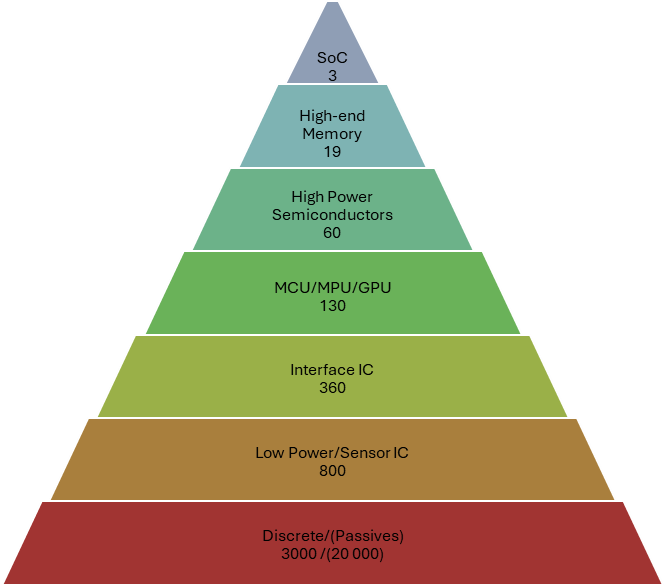
The same logic applies inside a vehicle. “In a car, semiconductors enable intelligence. Without them, safety features like automatic braking wouldn’t work, sensors couldn’t detect risks, navigation would fail, and electric vehicles couldn’t manage batteries or charging.” From simple components to advanced chips, nearly every function depends on semiconductor technology – even if it remains invisible to the user. At the same time, semiconductor technology evolves rapidly. “Physics sets limits – progress is no longer only about making transistors smaller. New directions are emerging, from different chip architectures such as Arm-based designs to research in quantum and other advanced technologies. For automotive, however, everything must fit vehicle requirements, production scale, and cost structure”.
What are lessons learned so far related to semiconductor strategy?
The main lesson, according to Parvaneh, is respect for complexity. “The semiconductor supply chain is long and complex. Cars are complex. When combined, the complexity increases. Complexity cannot be removed – it must be engineered around”. Automotive requires long product lifecycles, strict safety standards, and global supply networks. Semiconductor innovation, on the other hand, moves fast. Bridging these timelines requires stronger internal competence and earlier strategic involvement.
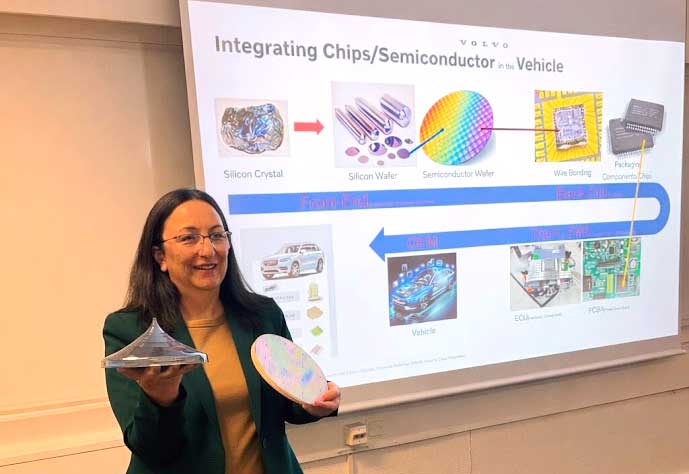
To raise awareness across the company, Parvaneh launched an internal course at Volvo Cars: Electronic Components and Semiconductors. The course introduces basic semiconductor concepts, supply chains, and strategic implications for managers, purchasers, and engineers. “Not everyone needs deep knowledge, but everyone needs understanding.”
How does Volvo Cars engage with other actors around semiconductor?
Parvaneh emphasizes competence, collaboration, and focus. Important areas include even stronger alignment between industry and academia and research that considers manufacturability early. “Sweden will not have a full semiconductor stack, but we can lead in specific niches through fabless design and system expertise. At Volvo Cars we are interested in new architectures and technologies, but everything must fit the vehicle, production, and cost structure.” Long-term ambition includes:
- Earlier involvement in defining standard components and ASICs
- Bringing automotive requirements earlier into the value chain
- Strengthening internal competence to support these discussions
Volvo Cars is a member of Svensk Elektronik, a member association for electronic companies in Sweden, and further Parvaneh participates regularly as a reference group member in the Swedish Chips Competence Center (SCCC) meetups.
How do we attract more talent, and increase diversity?
Volvo Cars collaborates long-term with universities through Master’s programs and thesis projects, PhD research and other competence-building initiatives. Building a car requires expertise across raw materials, electronics, architecture, software, and power electronics — and semiconductor knowledge is central to all of it. “We need more girls in this field as semiconductors are still very male-dominated.”

Parvaneh also highlights the need for change earlier in education:
- More modern, digital, and hands-on learning methods
- Better alignment with how younger generations learn
- Clearer paths for upskilling during working life
“New digital materials and gamified tools – even platforms like Minecraft with educational elements – show the potential of learning by building. When young people can experiment with circuits and see how things work, technology becomes real. We need a broader approach to reach both girls and boys early.”