


Long-term collaboration makes a competitive advantage
Sweden does not have large-scale chip manufacturing. Yet Swedish semiconductor technology plays an important role in advanced radar, sensing, and quantum systems used around the world.
According to Jan Grahn, professor at Chalmers University of Technology, Sweden’s strength lies in long-term collaboration between key actors and a deep understanding of how advanced chip technology adds value at the system level.
Where does Sweden fit in the global semiconductor landscape?
“When people talk about semiconductors, they often focus on fabs and chip volumes,” Grahn says. “But semiconductors are part of very long value chains. No country controls everything.”
Instead of large-scale manufacturing, Sweden has built its role around advanced niches closely connected to companies developing complete systems – in areas such as defence, telecom, automotive, space, and scientific instrumentation. “In these fields, it’s often not about price or volume,” Grahn adds. “It’s about performance, reliability, and making technologies work together in complex systems.”
Two examples – from semiconductor devices to systems through collaboration
Jan Grahn has seen the effects of system-level collaboration throughout his career. For 20 years, he led the GigaHertz Centre at Chalmers (today known as WiTECH). Drawing on this experience, he highlights two long-term innovation journeys in different semiconductor niches: radar and quantum. Both began in academic research environments and today generate global value and growth for Sweden.
Example 1: Gallium nitride (GaN) for advanced radar systems (Saab AB)
Gallium nitride (GaN) has become a key semiconductor for active electronically scanned array (AESA) radar, enabling higher power, efficiency, and lower weight. Saab’s GlobalEye is one platform that has benefited from this wide-bandgap technology. When GaN research began in the early 2000s, however, it was far from industrially mature, making early collaboration between academia and industry essential.
At Chalmers, researchers such as professor Niklas Rorsman worked closely with Saab and international semiconductor partners to test and de-risk GaN long before it became a standard. The focus extended beyond the chip to system-level capabilities, with partners like UMS, NXP, and Infineon contributing production expertise in a pre-competitive setting. After more than a decade, this collaboration delivered radar electronics with decisive performance gains, forming the basis for Saab’s next-generation systems. “Saab gained several years in development through this collaboration,” Grahn notes – an advantage of high value in global competition.
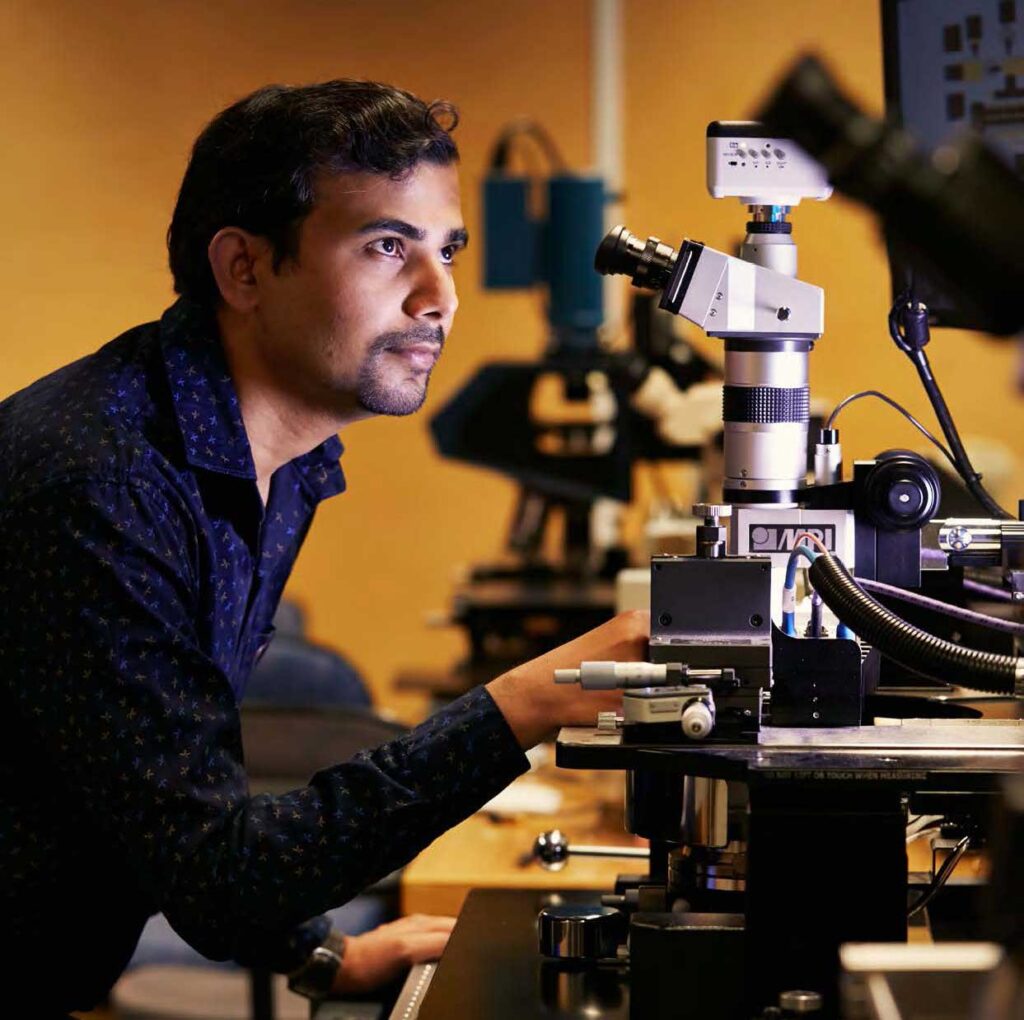
Saab was among the first global defence companies to showcase delivery-ready gallium nitride-based radar sensors. The collaboration with Chalmers researchers allowed Saab to speed up its development work to achieve this goal. “What mattered was not just a better component,” Grahn says, “but what that component added to the whole system.”
Example 2: Indium phosphide for quantum computing (Low Noise Factory AB)
The second example comes from a very different field, but follows the same logic. Indium phosphide (InP) is a compound semiconductor known for enabling extremely low-noise amplification in transistors. Originally, this capability was developed for space research and radio astronomy, where scientists needed to detect extremely weak microwave signals.
Over time, the same requirement emerged in quantum computing, where quantum bits must be amplified at cryogenic temperatures with minimum added noise. At Chalmers, InP devices were developed and tested in demanding environments for space, including work connected to the European Space Agency. Entrepreneur Nikclas Wadefalk recognised growing international interest – and the fact that universities were not the best choice for taking the InP technology from lab to fab. This led to the creation of Low Noise Factory, a spin-out from Chalmers that successfully commercialised the technology worldwide.
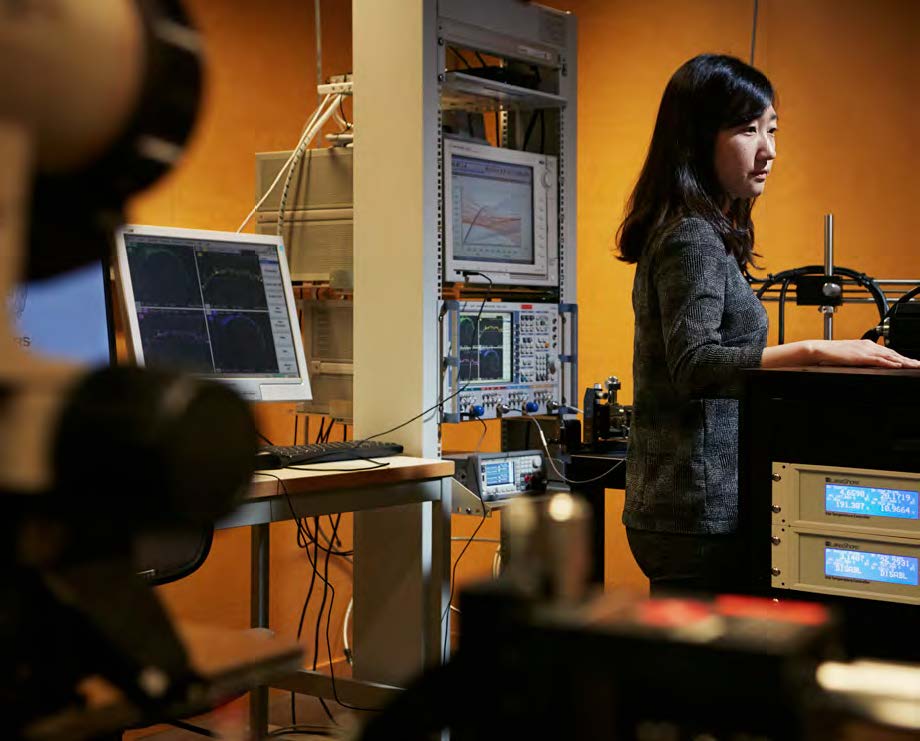
Former PhD student Eunjung Cha uses a cryogenic probe station down to 4 K to characterize low-noise InP transistors on-wafer up to 40 GHz. The results from such device measurements is used to design the cryogenic amplifiers, with state of the art results in noise temperature. Photo: Henrik Sandsjö.
Today, Low Noise Factory supplies ultra-low-noise amplifiers to quantum computing projects around the world. “The quantum and low-noise market is very different from radar,” Grahn notes, “but the pattern is the same: deep knowledge in semiconductors, long-term development in collaboration, and meeting a global market from day one.”
Time, trust, and shared problem-solving for system development
According to Grahn, both examples above rely on the same underlying conditions: time, trust, and shared problem-solving. Universities and industry bring different strengths. Academia can explore new technologies and absorb early technical risk. Industry provides real-world constraints, testing, and validation. Working together over time builds trust and allows knowledge to develop that neither side could create alone.
“What mattered most was not size, but long-term continuity involving the best partners in academy and industry, from semiconductors to systems,” Grahn says. “You cannot rush understanding – especially when working with new materials and new system requirements.”
What should be academia’s and Sweden’s role going forward?
Grahn sees universities as essential starting points for deep-tech innovation, in particular when they are closely connected to industry needs. Academia contributes long-term perspective, lab infrastructure,fundamental understanding and access to the international academic community. Industry contributes system knowledge, testing in real conditions, and access to global markets. When these roles are aligned, advanced research has a much higher chance of becoming useful in systems. “Soft knowledge – how systems behave in reality – can only be built together,” Grahn explains.
For Sweden, it is about focusing on areas where performance and system understanding matter most. “If we achieve excellence at the right time,” Grahn says, “we can be much more influential than our size suggests.” Attracting talent iscritical. Semiconductor technology is everywhere, yet often invisible. Making the field more visible – and connecting it to meaningful outcomes such as safer transport, greener energy systems, quantum computing, and space – is key to inspiring new generations. “You don’t start as a semiconductor expert,” Grahn says. “Curiosity is the key and that will lead you to the fascinating world of semiconductors.”