

From materials to prototypes: Uppsala’s role in Sweden’s semiconductor ecosystem
The Uppsala region is one of Sweden’s most dynamic and rapidly expanding knowledge hubs, driven by strong research environments, leading innovation ecosystems, and a diverse business community ranging from global industrial companies to small, entrepreneur‑led firms. With its strategic location near Arlanda Airport and strong connections to Stockholm, Uppsala has developed into a central node with two internationally leading universities, a top‑tier innovation support system, and a labour market that attracts highly skilled talent.
The region is particularly research‑intensive and plays a strategic role in Sweden’s semiconductor ecosystem: home to Sweden’s largest academic cleanroom facility and deep expertise in materials science, nanotechnology, and energy-related technologies. Uppsala also hosts a broad industrial base that relies on advanced semiconductor‑enabled components in sensor systems, instrumentation, and energy applications such as solar power and battery technology. This makes the region essential for early innovation, prototyping, materials development, and training the next generation of specialists. Uppsala’s strengths are further reinforced by its internationally recognised life science cluster. Here, universities, companies, and public actors collaborate closely on research, development, and industrial applications.
Myfab Uppsala and the Uppsala innovation system
Uppsala University is a globally recognized institution with leading expertise in materials science, nanotechnology, solid‑state physics, micro‑ and nanofabrication, quantum‑adjacent technologies, and energy‑related semiconductor materials. The university hosts the Ångström Laboratory, where Myfab Uppsala, Sweden’s largest academic cleanroom, is a node in the national research infrastructure for micro‑ and nanofabrication. Myfab Uppsala provides open‑access facilities for advanced R&D, materials characterisation, device processing, lithography, thin‑film engineering and prototyping used by both researchers and companies.
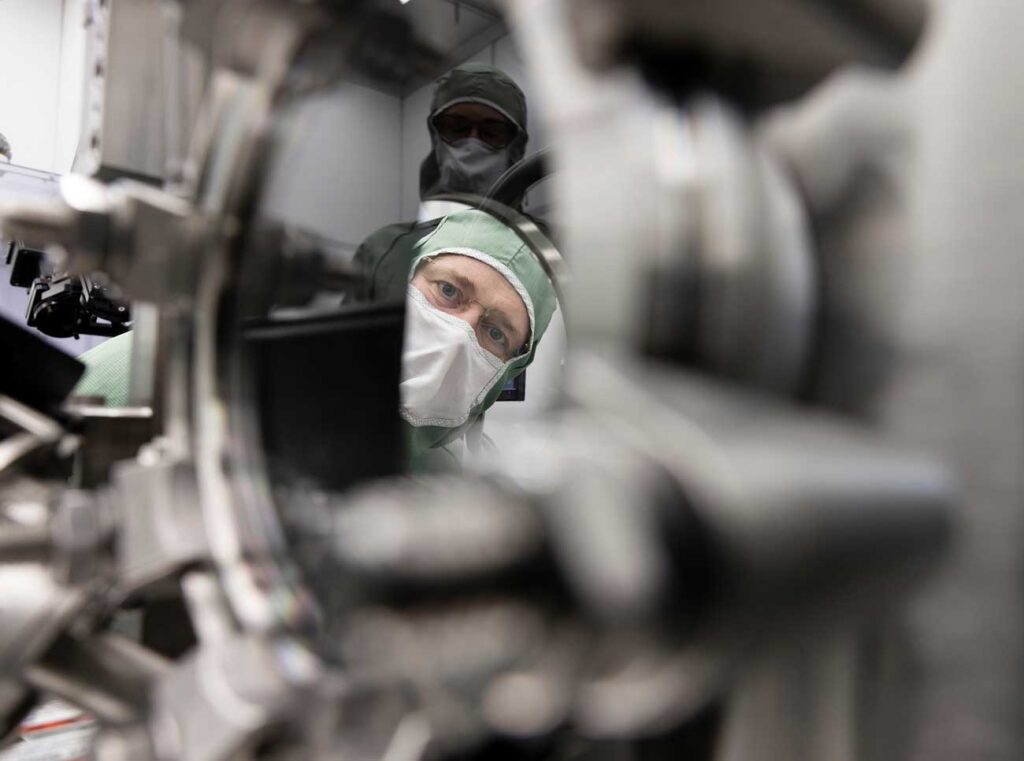
The innovation ecosystem is mature and well‑structured. Organisations such as STUNS, Uppsala Science Park, Uppsala Business Park, and university innovation offices work together to support commercialisation, business development and cluster growth. Uppsala Innovation Centre (UIC) and the broader Innovation Hub Uppsala provide strong support structures for deeptech startups and SMEs working with semiconductor‑relevant technologies, including sensors, instrumentation, materials and energy systems.
The region’s Smart Specialisation Strategy 2022–2027 further strengthens this foundation by focusing on challenge‑driven and knowledge‑intensive innovation in areas where Uppsala has distinctive advantages — life science, sustainability, energy, advanced technology, and complex societal challenges.
Future growth and collaboration: semiconductor’s Uppsala
Myfab Uppsala recently received substantial national and EU Chips Act–linked investment to expand semiconductor‑relevant capability explicitly aimed at strengthening Sweden’s semiconductor R&D capacity. In Uppsala, upgrades explicitly include student involvement in semiconductor cleanroom activity, ensuring early exposure and strengthened recruitment pipelines. The investments make Uppsala essential for Sweden’s positioning in semiconductor materials R&D, nano‑ and microfabrication prototyping, instrumentation and sensor development, energy and electrification technologies and deeptech life‑science instrumentation, and places Uppsala as a core national R&D node, enabling prototyping, early‑stage device development, and process innovation used by companies and researchers across Sweden.